
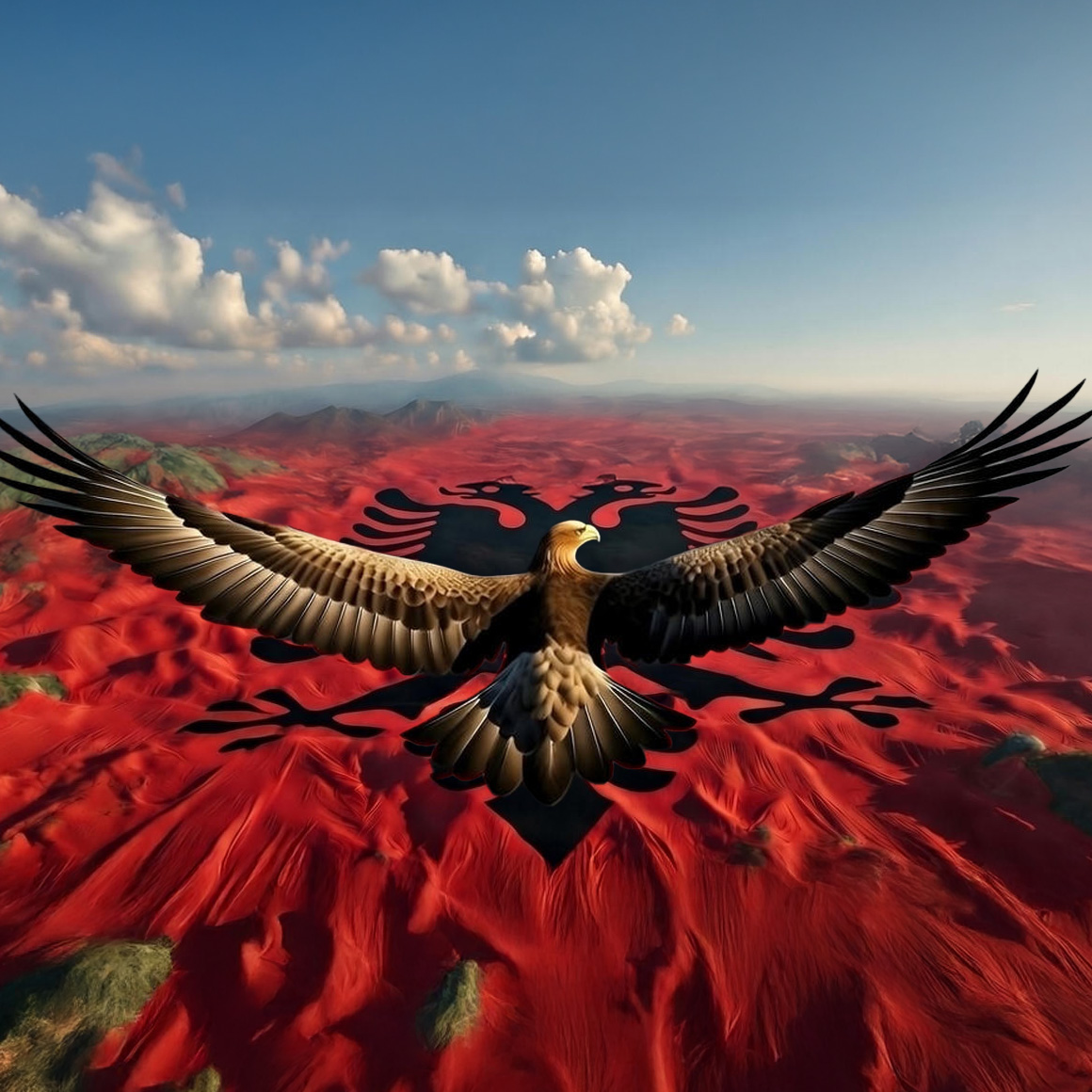
They call it Shqipëria—
land of the eagle,
where pride stretches from mountain spine
to distant shores where Albanians breathe the world.
I have lived among them a little while,
long enough to feel it:
a fierce love for who they are,
for where they come from,
for the black eagle pressed into red cloth,
wings spread wide over memory and blood.
Yet I have learned another truth—
that not all who wear the eagle
live as one.
Some are shaped like eagles
but think like vultures:
they love the symbol,
the badge, the name,
but circle what is dying,
living on what is left behind.
The double-headed eagle stares
forward and back—
not twice as strong in vision,
but split, unsure,
watching yesterday
while tomorrow waits.
The eagle is different.
It is singular.
Focused.
It soars alone if it must,
high where the air is thin and clean.
It does not wait for decay.
It hunts what is good, what is fresh,
what is worth the flight.
It does not waste strength
on battles that poison the wings.
It chooses wisely—
first the easy prey,
then, with age, greater things—
always forward,
never feeding on death.
The vulture smells ruin.
It gathers in numbers.
It descends into rot,
tearing at what once lived,
content with scraps,
its belly full,
its feathers stained.
Big birds, even beautiful at a distance,
so like the eagle
that many cannot tell them apart.
Proud, yes—
but filthy with yesterday.
And Albania stands there now,
between sky and carcass,
remembering who it was.
From under empire,
from under silence,
from under concrete fear,
it lifts its head.
It hungers again—
for freshness,
for goodness,
for freedom.
To own the sky.
To choose the best.
To remember its calling.
This is not nostalgia.
This is awakening.
This is the call
not of the vulture,
but of the eagle.
